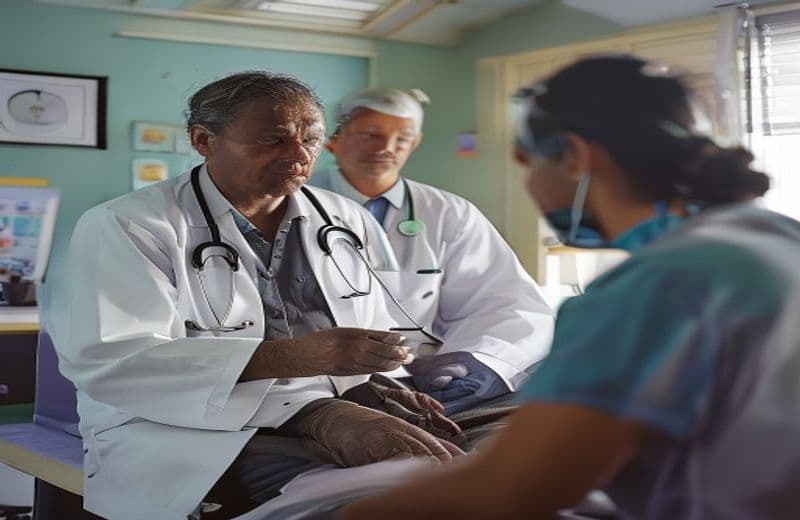
Health
Sustainable Development Goal 3 aspires to ensure health and well-being for all at all ages.
To undertake health and hygiene promotion activities and set up Health Care Centers for those who cannot afford treatment.
Sustainable Development Goal 3 aspires to ensure health and well-being for all — including the commitment to end the epidemics of AIDS, tuberculosis, malaria and other communicable diseases by 2030, to achieve universal health coverage, and to provide access to safe and effective medicines and vaccines for everyone. Pakistan is a signatory to the SDG Agenda 2030.
Improving the health and nutrition of the population sits high on the national agenda, with growing focus on rebuilding and strengthening primary and secondary healthcare facilities. The basic health indicators are moving in the right direction, but the pace is slow — and spending on health has remained below one percent of GDP for decades. That is the key structural challenge.
There has been real progress. Between 2012-13 and 2017-18, stunting among children fell from 45 to 38 percent, wasting from 11 to 7 percent, and the prevalence of underweight children from 30 to 23 percent. Infant mortality dropped from 86 deaths per 1,000 live births in 1990 to 61.2 in 2017; under-five mortality from 112 to 74; and neonatal mortality from 55 in 2012 to 42 deaths per 1,000 live births.
By 2018 the country had 1,279 public sector hospitals, 5,527 Basic Health Units, 686 Rural Health Centres and 5,671 dispensaries, alongside 220,829 registered doctors, 22,595 registered dentists and 108,474 registered nurses. In practice that works out to one doctor for every 963 people, one dentist for every 9,413, and one hospital bed for every 1,608 individuals.
For a family living on daily wages, those ratios come down to a simple problem: the treatment exists, but it is out of reach. Noor-e-Kainat Welfare Trust provides free and low-cost medical care and medicines, runs free medical camps in underserved areas, and is building its own welfare hospital so that quality treatment does not depend on the size of a family's income.
Figures cited from the Pakistan Economic Survey 2018-19, the Pakistan Demographic and Health Survey 2017-18, and the UNDP Human Development Report 2018.
Your generosity makes this work possible. Together we can extend this service to more families across Pakistan who need it most.